
Did I go out too fast? How to read your running splits (and pace your next 5K)

You finish a 5K, stop the tracker and check the time. 36 minutes. You were sure you were on pace for 35, because the first kilometer felt amazing.
Short answer: you probably went out too fast, and your splits will tell you. A split is the time you took for each kilometer. If your first kilometer is much quicker than your last, you spent energy early that you paid back with interest later. The fix is simple: run the first kilometer a little slower than you want to, hold a steady pace through the middle, and save your fastest kilometer for the end.
Here's how to read your splits, with worked examples.
What a split is
Your tracker's average pace hides the story. "7:00 per km average" could mean you ran every kilometer at 7:00. It could also mean you started at 6:20 and crawled home at 7:50.
Splits break the run into pieces, usually one per kilometer. A 5K gives you five numbers, and the pattern between them is what tells you how you paced it.
The three shapes of a run
Compare the second half of your run with the first half.
Positive split: the second half is slower. You started faster than you could hold. Most beginners run this shape.
Even split: both halves are within a couple of percent of each other. For most distances, it's the most efficient way to run.
Negative split: the second half is faster. You held back early and finished strong. Most coaches want you to aim for this one.
A small positive split is normal. Being 2 to 5% slower at the end of a hot run is not a disaster. Past about 5%, it's a fade: you were running a pace your body couldn't hold. For someone averaging 7:00 per km, 5% is about 20 seconds per km.
Same goal, three different 5Ks
Take three runners who all want to finish a 5K in 35 minutes, which is 7:00 per km. These numbers are illustrative, not from a study, but the pattern shows up on run trackers every weekend.
Kilometer by kilometer:
Runner A (fast start): 6:20, 6:50, 7:20, 7:40, 7:50. Finish: 36:00.
Runner B (even): 7:00 for every kilometer. Finish: 35:00.
Runner C (negative): 7:10, 7:05, 7:00, 6:55, 6:45. Finish: 34:55.
Runner A was 40 seconds ahead of goal after one kilometer and felt great. By the finish she was a full minute behind. She banked 50 seconds in the first two kilometers and gave back 110 in the last three.
Runner C was 10 seconds behind after one kilometer, and probably felt like she was holding back too much. She finished first.
Why a fast start costs more than it saves
In the first kilometer you're fresh and your legs haven't complained yet. A pace that is too fast for you still feels easy for the first few minutes, because your body hasn't caught up with how hard you're working.
Once you go above the effort you can actually sustain, fatigue builds faster than your body can clear it. You can't bank that time. You borrow it, and you pay it back at the worst moment, in the last two kilometers, when you're already tired and slowing down feels unavoidable.
Running a little under your limit early keeps that fatigue in check, so you still have something left when it counts.
How to pace a beginner 5K
If you don't have a goal time yet, use your last 5K's average pace as the target and try to run every kilometer close to it.
Kilometer 1: hold back on purpose. Start about 10 seconds per km slower than your target. It should feel controlled, almost too easy: breathing quicker, not ragged. If it doesn't, slow down.
Kilometers 2 and 3: settle in. Lock into your target pace. You can still talk, a few words at a time.
Kilometer 4: hold it. This is the hardest one mentally. Don't speed up yet and don't let it slide.
Kilometer 5: spend what's left. If you have anything in the tank, this is where it goes.
Run-walking is completely fine too. Splits still work: if your walk breaks get longer and more frequent near the end, that's the same fade showing up in a different way.
Reading your own splits
A few things to check after every run:
Compare the halves, not single kilometers. Is the second half slower, even or faster than the first?
Ignore one strange kilometer in the middle. A single slow km between two normal ones is usually a stoplight, a hill, a crowd at the water station or a GPS dropout. Tall buildings in BGC and the thick acacia trees around the UP Academic Oval can both make a phone lose its signal for a moment. One odd kilometer isn't a pattern.
Look at your last kilometer. If it's your slowest, you started too fast. If it's your fastest, your pacing worked.
Compare like with like. Your 5 AM runs and your 5 PM runs are different runs.
Heat, humidity and Metro Manila
Hot, humid weather slows almost everyone down. A 2007 study of big-city marathon results (Ely and colleagues) found finishing times get slower as race-day temperatures rise, and that is in cooler cities than ours. Even at 5 AM, Metro Manila is often already around 25°C with high humidity.
What that means for your splits:
Don't compare a midday run with an early morning one. The slower splits are the weather, not your fitness.
On hot days, start even slower. Heat makes a fast start cost more, so the gap between Runner A and Runner C gets wider.
On runs over an hour, carry a drink. Water, plus something with sugar or electrolytes for the longer ones. In our heat you sweat more than you notice.
Stopping at crossings
Every runner in the city knows this one. You hit the light at the corner, wait two minutes for traffic, then keep going. If your tracker is still running, that two-minute stop gets added to the kilometer you were in, and your splits make you look much slower than you ran.
Tap pause when you stop, and resume when you go. Most run trackers also have an auto-pause option that does it for you when you stand still. Your splits then show your running time, which is what you want to judge your pacing on. Your total time on the clock is a separate number, and on race day it's the one that counts.
The whole answer, in five lines
Your splits are your time per kilometer. The pattern matters more than the average.
Second half slower by more than about 5%: you started too fast.
Start the first kilometer about 10 seconds per km slower than your target.
Ignore one odd kilometer. Look at the halves and the last kilometer.
Pause at crossings, and compare morning runs with morning runs.
If you want your splits without the math
I built an app called EnsayoHub that now shows this for you. Track a run, walk or ride with GPS in the app, and the summary shows your pace for every kilometer, one row each with a bar, with your fastest whole kilometer highlighted. Pause at a crossing and that stop doesn't count against the kilometer you were in. Your personal records come from your real kilometer splits instead of your average pace, and you can ask your coach if you went out too fast. Runs you logged before this update won't have splits. Free to start.
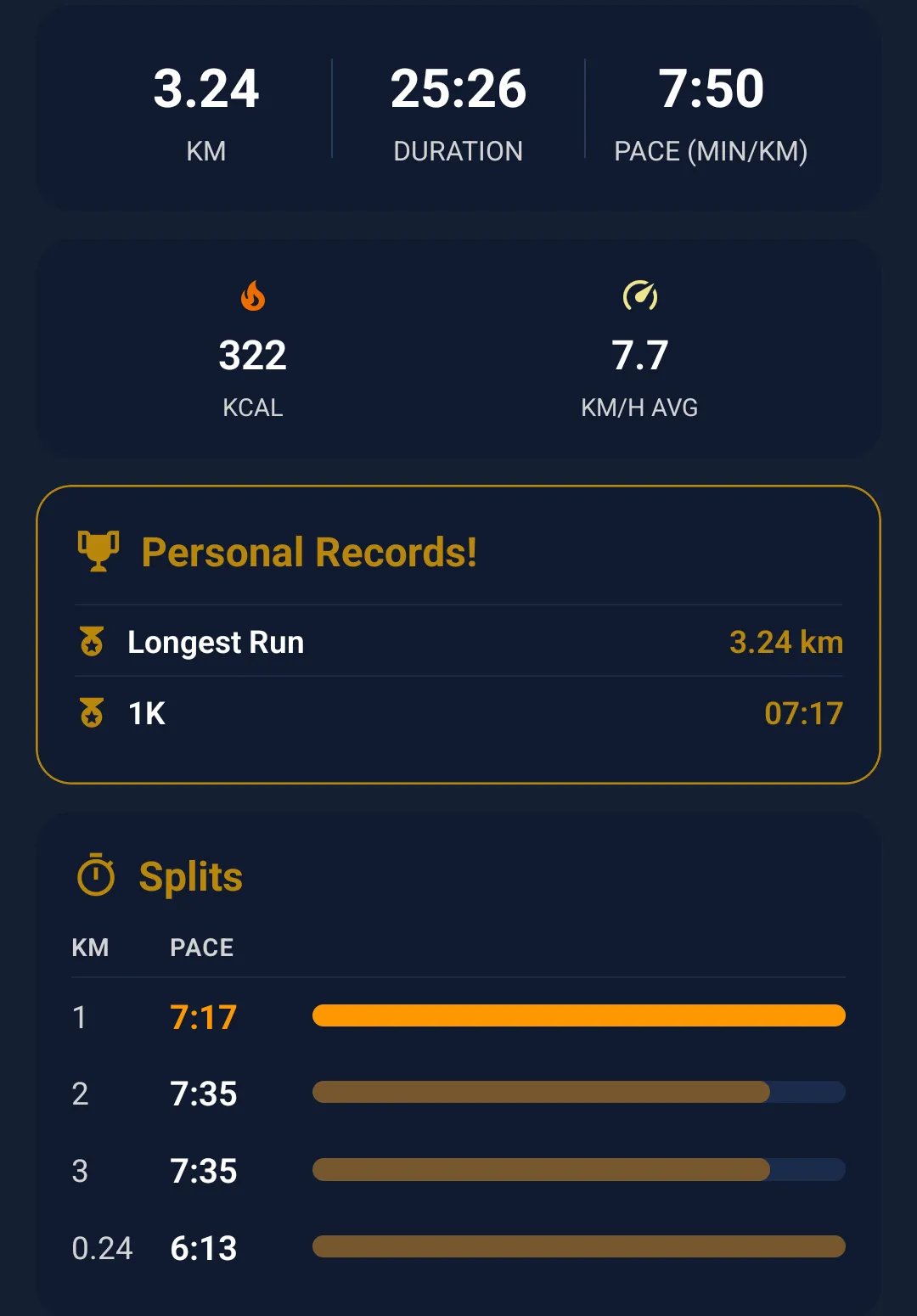
From my test account: 3.24 km around the UP Academic Oval. Kilometer 1 is the fastest, then the pace settles slower, exactly the pattern this post is about.
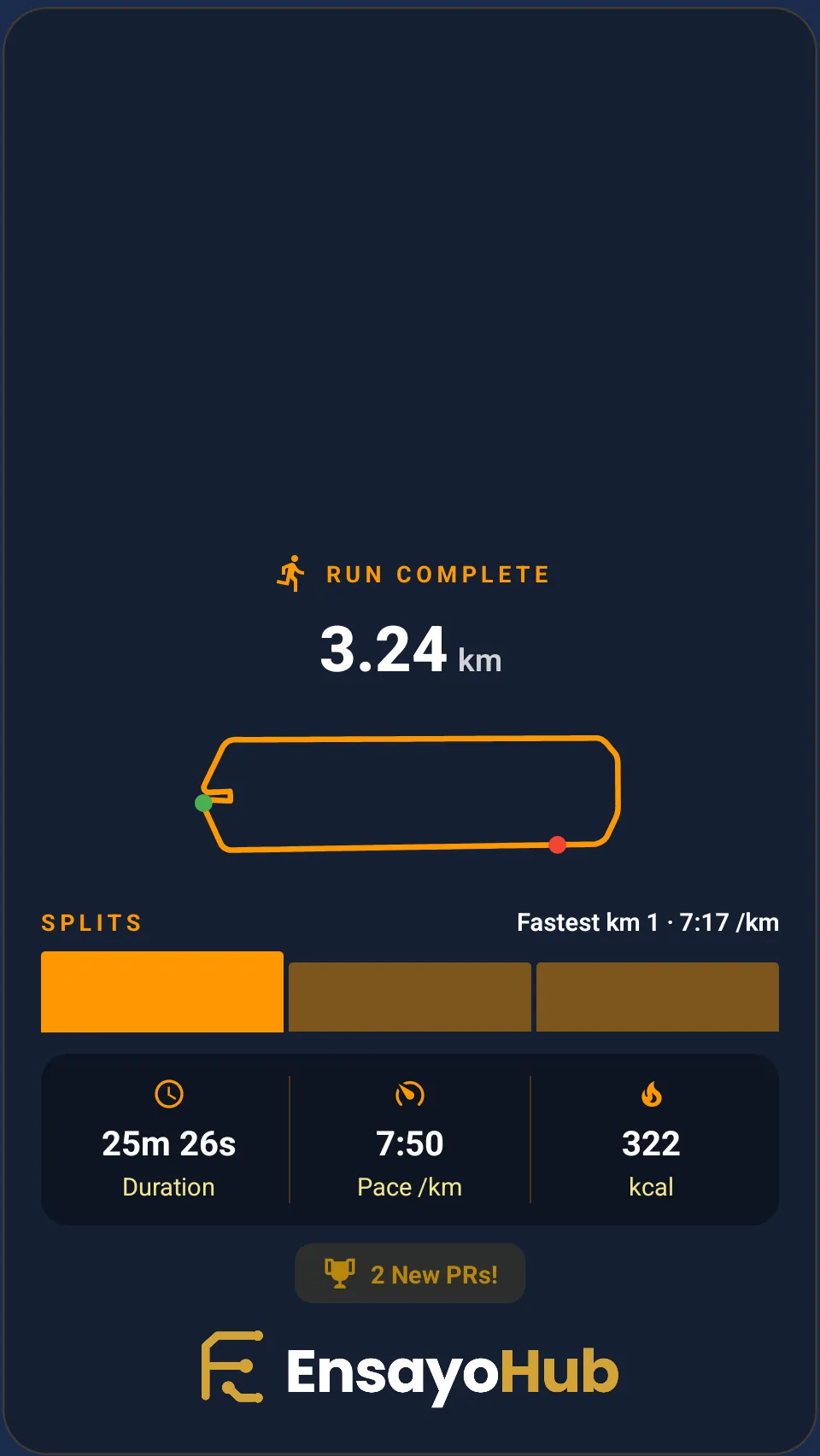
Download: https://ensayohub.com/#download
And even without the app: start slower than you want to, finish faster than you started.