
How to learn a combo you've only seen written down
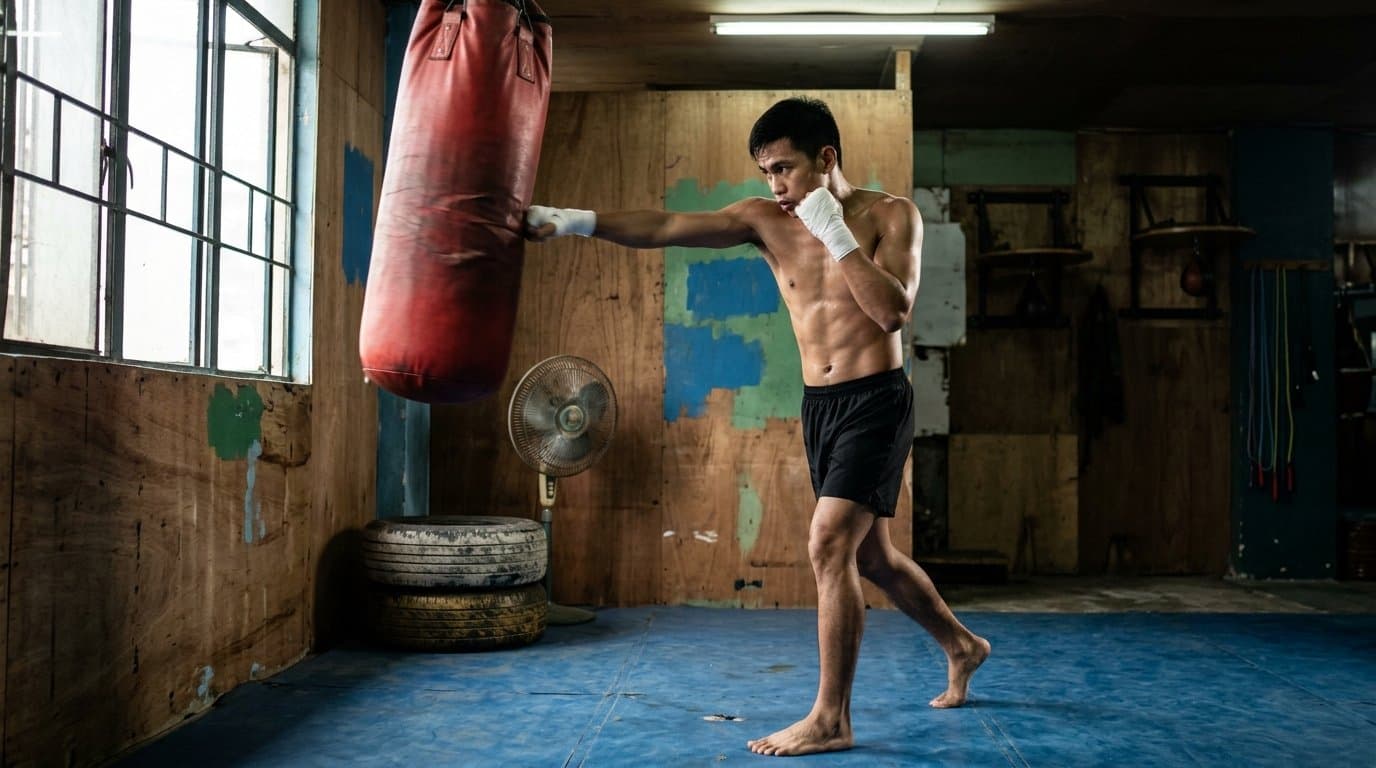
Your round says "Jab, cross, lead hook, rear low kick." The timer is already running. You know what each word means, more or less, but not what the whole thing should look like, so you throw something fast and hope it's close.
Short answer: learn the four strikes as four still positions first, then connect them slowly, coming back to your guard after each one. Add speed only once the slow version looks right, and power after that. Count it out loud as you go. In twenty years of Muay Thai, I've watched most beginners do it the other way around, fast first and clean later, and the bad habits stick.
Here's the whole method, using that combo as the example. The same steps work for any combo in boxing, Muay Thai or kickboxing.
First, know what each word means
Everything below assumes an orthodox stance: left foot and left hand in front. If you're a southpaw, flip every left and right.
Jab: a straight punch with your lead (front) hand. Light and fast, it sets up whatever comes after it.
Cross: a straight punch with your rear (back) hand. It travels across your body, which is where the name comes from, and it's usually your hardest punch.
Lead hook: a short, curved punch with your front hand, arm bent, aimed at the side of the head.
Rear low kick: a kick with your back leg into the outside of the other person's thigh, landing with your shin.
Step 1: Learn each strike as one still picture
Every strike has one moment that matters: the instant it lands. If you can hold that position correctly, you know the strike. Everything else is getting in and out of it.
Stand in front of a mirror, or prop your phone against the wall and record yourself. Move into each position slowly, hold it for two seconds, check it against the list, and come back to your guard.
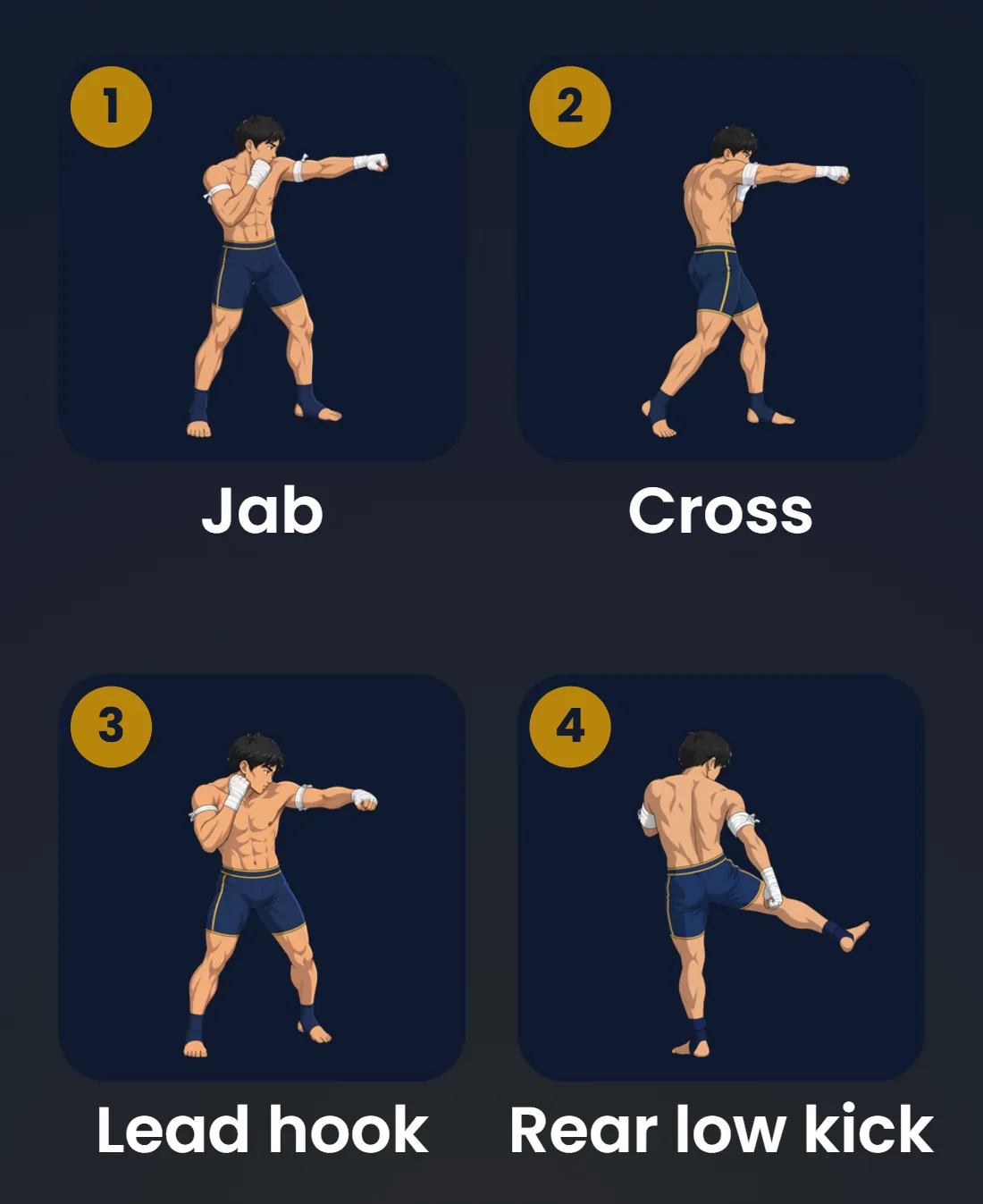
The jab, at the moment it lands
Lead arm straight, fist turned palm down.
Lead shoulder raised so it covers your chin.
Rear hand still at your cheek.
Feet in your stance. Your weight barely moves.
The cross
Rear arm straight, palm down.
Rear heel turned out, so you're up on the ball of your back foot.
Hips and shoulders turned toward the target.
Lead hand back at your face.
Head no further forward than your front knee.
The lead hook
Front arm bent at roughly a right angle, elbow about level with your fist.
Front heel turned out, so your lead foot pivots with the punch.
Hips turned back the other way from the cross.
Rear hand guarding your chin.
The rear low kick
The lower half of your shin across the outside of their thigh, about halfway between knee and hip.
Standing foot turned out until its heel points at the target. This is what lets your hip turn over.
Hips turned all the way through.
Lead hand up at your face. In Muay Thai, the rear arm often swings down and back for balance, and that's normal.
Step 2: Stance, strike, stance
Now add movement. Go from your guard into the jab's landing position and straight back to your guard, at about half speed. Do the same with each strike, five times each.
Coming back matters as much as going out. In sparring, the hand that's slow to come home is the side you get hit on. Drill "strike, then guard" from day one and your hands will start going back without you thinking about it.
Step 3: Build the combo one strike at a time
Don't try all four at once. Build the chain:
Jab, back to guard.
Jab, cross, back to guard.
Jab, cross, lead hook, back to guard.
Jab, cross, lead hook, low kick, back to guard.
Move to the next line only when the current one looks right three times in a row. It's the same way you'd memorize a phone number: in chunks first, then the whole thing.
While you're learning it, bring each hand back to your face before the next strike, but let your hips keep turning. It will feel slow and a little robotic for the first few sessions. Once each position is automatic, the strikes start to flow into each other on their own.
Step 4: Count the rhythm, and breathe out
Say it out loud: "One, two, three, kick." Keep the beats even, like a metronome.
Breathe out on every strike, a short sharp exhale through your nose or a "tss" through your teeth. Holding your breath is a big reason a beginner is gassed after one round of shadow boxing, especially in a room with no aircon.
Later, your coach may teach you to break the rhythm: a quick jab-cross, a beat, then the hook. Learn the even version first.
Why this combo flows: each strike sets up the next
The order isn't random. Each strike turns your body in a way that loads the next one.
The cross turns your hips and shoulders forward.
The lead hook turns them back the other way.
That turn winds your rear hip back, ready to swing through for the low kick.
This is also where the power comes from. A strike is strong when it starts at the floor: the foot pivots, the hips turn, the shoulders follow, and the fist or shin arrives last. If your feet don't move, you're hitting with your arm alone, which is weaker and tires out your shoulders fast. A back heel that turns on the cross and a front heel that turns on the hook are the two quickest signs you're doing it right.
The mistakes almost every beginner makes on this combo
Dropping the rear hand on the jab. It drifts down to your chest as you punch. Keep it at your cheek.
No pivot on the cross. The back heel stays flat, so the hips can't turn.
Winding up the hook. Pulling the arm back before you throw it is slower, and your sparring partner sees it coming. Throw it from where your hand already is.
A low elbow on the hook. The punch turns into a wide, loopy swing.
Kicking with the foot. On a low kick, the shin is the weapon. The top of the foot and the toes are small bones, and they get hurt on a hard target.
A flat standing foot on the kick. If it doesn't turn out, your hip can't turn over and your knee takes the twist instead.
Dropping the leg in front of you after the kick. Bring it back to your stance.
Rushing. Four sloppy strikes in one second teach you four sloppy strikes.
Shadow boxing first, then the bag
Shadow boxing (throwing combos in the air, with no target) is where you learn the shape. You can watch yourself in a mirror, nothing pushes back, and it fits in a condo living room. Stop just short of locking your elbow on the straight punches. Snapping it to a hard lock in the air is rough on the joint.
The heavy bag teaches what the air can't: distance and impact. You'll find out quickly that your hook only lands when you're close, and that the low kick needs a small step out with your front foot to get the angle. Wrap your hands and wear gloves before you hit a bag, and kick it lightly for the first few weeks while your shins get used to it.
A simple first week with a new combo:
Day 1: still positions, then stance-strike-stance on each strike. Ten minutes is enough.
Day 2: build the chain one strike at a time, then 2 rounds of 2 minutes of shadow boxing, slow.
Day 3 onward: 2 rounds slow, 2 rounds at your normal speed, then 2 rounds on the bag.
The whole method, in five lines
Learn each strike as a still position: the moment it lands.
Stance, strike, stance. Always come home.
Build the chain one strike at a time.
Count it out loud and breathe out on every strike.
Speed once it's clean. Power once it's fast.
If you'd rather see it than read it
I built an app called EnsayoHub, and its martial arts plans now show you the combo instead of just naming it. In shadow boxing, heavy bag and drill rounds, the round's combo plays as an animated drawing, thrown by your coach in the app (Fury by default, or Katana). Tap a step to freeze on its key moment (the punch landing, the kick at full extension), then step through with the arrows. Set it to Slow while you learn it; even Normal is slower than fight speed, so you can count along. The fighter resets to stance between strikes so each one reads clean. About 90 boxing, Muay Thai and kickboxing techniques are drawn so far, and a step without a drawing shows its name instead. Free to start.
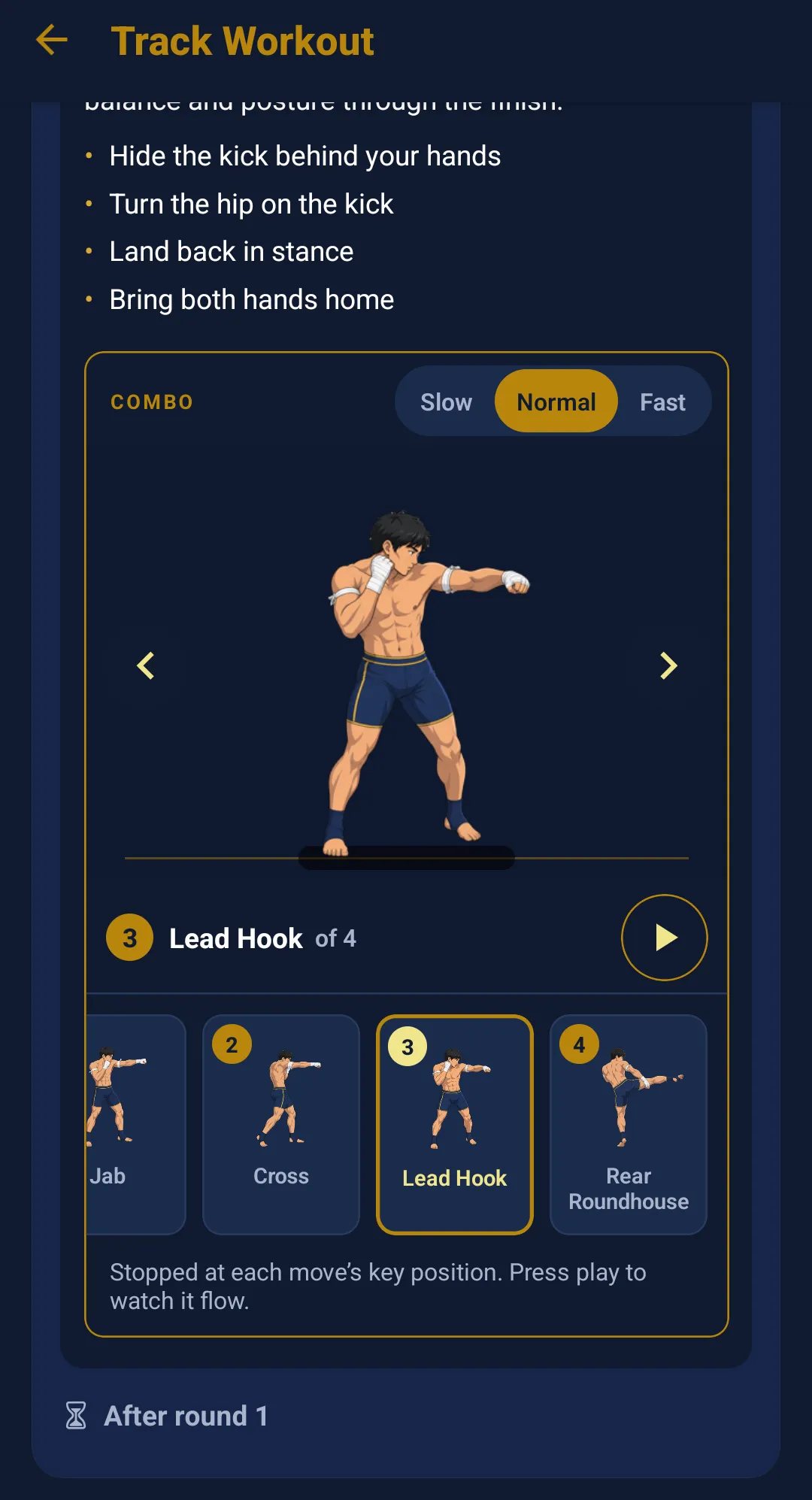
From my test account: a jab, cross, lead hook, rear roundhouse round, paused on step 3.
Download: https://ensayohub.com/#download