
Should you eat back the calories you burned? Net vs gross, with the math

It's one of the most common questions in calorie deficit groups: "I worked out and my watch says I burned 300 calories. Can I eat that back?"
Short answer: yes, but your workout should only be counted once. One of the most common reasons people hit their target every day and still don't lose weight is that their workouts are being counted twice, and they don't know it. And the people who never eat any of it back end up hungry, tired, and bingeing by Saturday.
Here's the math, step by step.
Gross vs net, in one line each
Gross: everything you ate today.
Net: what you ate, minus what you burned training.
Your weight follows your net, compared against your everyday burn: the calories your body uses on a normal day outside your workouts. Sleeping, working, commuting, housework. That's the number your deficit should come from.
Mistake #1: double counting (the "on target but not losing" problem)
Most free TDEE calculators ask how often you exercise, and the answer you pick is built into your number. "Exercise 3 to 5 days a week" multiplies your base burn by about 1.55. Compared to a desk-job day, that's roughly 400 to 600 extra calories a day already inside the target.
Then you log your workout in a fitness app, and it adds the burn again.
Take Maria: 28, 160 cm, 68 kg, desk job, trains 4 times a week. Her base burn (BMR, using the Mifflin-St Jeor formula most calculators use) is about 1,380 calories.
Calculator with exercise inside (x1.55, "exercise 3 to 5 days"):
Daily burn before training: ~2,140
Weight-loss target (minus 400): ~1,740
Training day, 250 burned and logged: she eats ~1,990
Everyday burn only (x1.2, desk job, outside workouts):
Daily burn before training: ~1,655
Weight-loss target (minus 400): ~1,255
Training day, 250 burned and logged: she eats ~1,505
Same Maria, same workout. With the calculator number, she "hits her target" every single day, and still eats about 480 calories a day more than she should. Her 400-calorie deficit is gone, plus a little. That's why the target looks right and the scale doesn't move.
Where does the 480 come from? Two leaks, averaged over her week:
Counted twice (about 140 a day). The x1.55 already assumes she trains, and then every workout she logs gets added again. Her 4 sessions of 250 average about 140 a day, all of it counted twice.
The multiplier guesses high (about 340 a day). x1.55 assumes about 480 a day of exercise. She actually does about 140.
The fix: build your goal from your everyday burn, then add each workout once, on the day you do it. The other way (a calculator with exercise inside, and you never add the burn) only works if the multiplier matches your real training. For Maria it doesn't: even with no double counting, her deficit shrinks to about 60 a day. A multiplier also assumes you trained during the week you got sick and skipped everything.
Mistake #2: never eating any of it back (the "starving by the weekend" problem)
The opposite mistake looks disciplined. Maria eats exactly 1,255 on a day she trained and burned 250. Her net for the day is about 1,005.
Her real deficit that day is about 650, not the 400 she planned. One day like that is fine. Every training day, though, and you know how it goes: hungry, weak in the next workout, and by Saturday, unlimited Korean barbecue with no brakes.
A diet you can keep for 12 weeks beats one you quit after 12 days.
The one number to track: calories left
Instead of juggling eaten, burned and target in your head, track one number:
calories left = goal - eaten + burned
Goal: your everyday burn minus your deficit (about 1,255 for Maria).
Eaten: everything. Including the cooking oil, the dipping sauce, and the second cup of rice.
Burned: only the workouts you actually did today.
On a rest day, Maria starts with 1,255 calories left. On a day she trained and burned 250, she starts with 1,505. The day you train, you get to eat a bit more, once. That's it.
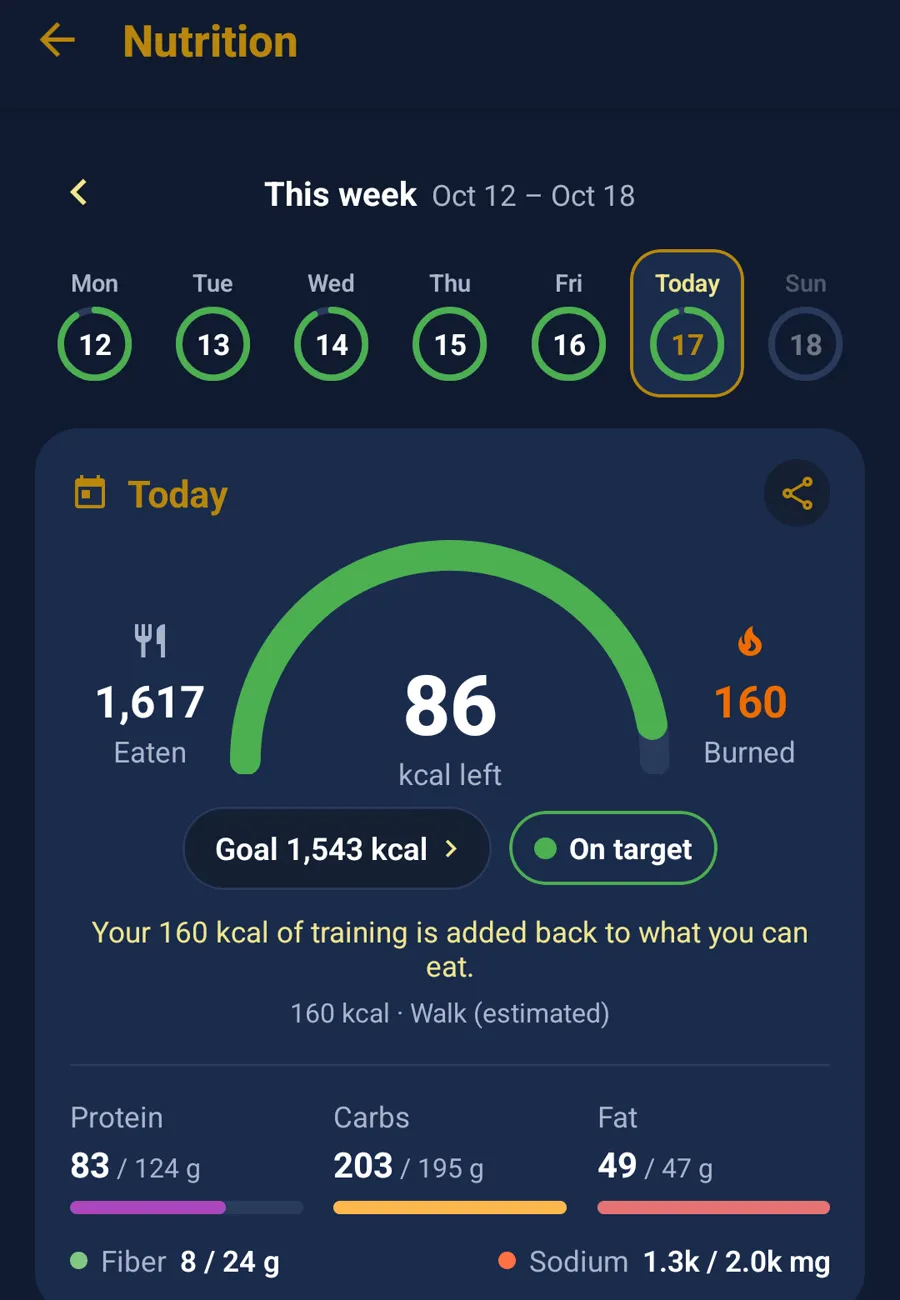
Example from my test account: goal 1,543, eaten 1,617, burned 160 on a walk. 1,543 - 1,617 + 160 = 86 calories left. Over the goal on paper, still on target, because the walk counted.
What if the burn estimate is wrong?
This is the part people rarely talk about: every burn number is an estimate. Your smartwatch, the treadmill screen, any app (mine included). A 2017 Stanford study tested seven popular wrist devices, and none of them had a median error under 20% on calories burned. Newer watches may do better, but it's still an estimate.
So treat the burn as an educated guess, not a receipt. If you've logged honestly for 3 to 4 weeks and your weight trend hasn't moved, check in this order:
Your logging first. Cooking oil, sauces, drinks, the extra rice. That's where most "mystery" calories come from. Measure your rice for one week. You'll be surprised.
Your trend, not your daily weight. A salty dinner can put 1 kg of water on you overnight. Look at the weekly average.
Then the burn. Eat back only half of what you burned for two weeks and watch the trend again.
1,000 calories left at 6 PM. What's for dinner?
This is where the number earns its keep. Say you have about 1,000 calories left and you're low on protein (most of us are by dinner). You don't need special diet food. A normal Filipino plate works, sized right:
Chicken adobo bowl: around 150 g cooked chicken, 1 cup rice, and 2 cups of vegetables (pinakbet or a simple vegetable stir-fry).
Tuna and egg plate: one can of tuna, drained, 2 eggs, a grilled eggplant or tomato-cucumber salad, and 1 cup rice.
Sauteed tofu with rice, if you want a cheaper protein.
Notice there's rice in all three. Rice isn't the enemy. One cup of cooked white rice is about 200 calories. Knowing how many cups you're eating is the whole point.
The whole answer, in five lines
Your weight follows net, not gross.
Build your goal from your everyday burn, then add each workout once.
Don't eat 1,200 on a day you burned 300 and call it discipline.
Burn numbers are estimates. If you're stuck, fix the logging first, then eat back half.
Track calories left, one number, instead of three.
If you'd rather not do the math
I built an app called EnsayoHub that does this for you. Your goal comes from one question about your day outside the gym, every workout you log gets added back, and the Nutrition screen puts one number front and center: calories left. Snap a photo of your plate to log it (free accounts get a daily number of AI scans), or tap "Log again" for meals you eat often. You can also ask the AI coach what to have for dinner with the calories you have left. Free to start.
Download: https://ensayohub.com/#download
And even without the app: goal from your everyday burn, add the workout once, count the rice. That's the whole answer.